
ASHUR INSIGHTS / ENERGY INTELLIGENCE
Research cut-off: 27 October 2026
Public-source analysis · Baghdad and southern Iraq
EXECUTIVE SUMMARY
On 21 October 2026, Basra Oil Company (BOC) and ExxonMobil signed a memorandum of understanding concerning a proposed second phase of Iraq's seawater-utilization infrastructure. The Ministry of Oil announcement, reproduced by the National Iraqi News Agency, describes capacity of up to 2.5 million barrels of seawater per day to support oilfields and reservoir-pressure maintenance. It is an MoU: the announcement does not establish a final investment decision, a binding engineering, procurement and construction (EPC) award, a construction schedule, or delivered water volumes. NINA report on the seawater MoU (Arabic) · NINA report on the seawater MoU (English)
The proposal would complement the separate Common Seawater Supply Project (CSSP) led by TotalEnergies, whose announced treatment and supply capacity is 5 million barrels per day. TotalEnergies announced the start of CSSP construction in September 2025. TotalEnergies construction update
Adding the announced capacities gives an indicative total of up to 7.5 million barrels per day. That arithmetic is not an operating statistic: both figures refer to planned seawater capacity, and the ExxonMobil phase remains proposed. Neither figure represents crude-oil production.
WHY SEAWATER INFRASTRUCTURE MATTERS
As oil and water are produced, reservoir pressure and the reservoir's natural energy may decline. Water injection can provide pressure support; a waterflood can also displace oil toward producing wells. Those terms describe related but distinct operating purposes. Performance depends on the reservoir, fluid properties, geology, well pattern, water quality and operating strategy. Injection does not automatically produce the same recovery or production response in every field. SPE PetroWiki on waterflooding · SLB definition of waterflooding
The infrastructure challenge is therefore broader than securing a large water source. A supply system has to deliver water of suitable quality, at the required pressure and rate, to field interfaces that can accept it. Reliability matters: treatment availability, pumping, power, pipeline integrity, maintenance and coordination with injection operations all affect whether a designed capacity can be used.
There is also a resource dimension. TotalEnergies says its CSSP is intended to substitute treated seawater for freshwater currently taken from the Tigris, Euphrates and aquifers for oil-well pressure maintenance. The company has said this could free up to 250,000 cubic metres of freshwater per day for irrigation and local agriculture. This is a stated project expectation, not a verified current saving or operating result. TotalEnergies construction update
TWO PROJECTS, TWO DIFFERENT STATUSES
| Attribute | TotalEnergies CSSP | ExxonMobil proposal |
|---|---|---|
| Announced capacity | 5 million barrels of seawater per day. | Up to 2.5 million barrels of seawater per day. |
| Public status | Project in execution; construction announced in September 2025. | MoU for a proposed second phase, signed 21 October 2026. |
| Publicly confirmed scope | Treatment plant and pipeline packages have publicly identified contractors. | The MoU announcement does not identify a final EPC award or detailed delivery scope. |
| Operating output | Do not equate design capacity with water currently delivered. | No operating output established. |
| Evidence to watch | Construction, commissioning and verified delivery milestones. | Definitive agreements, engineering decisions, contract awards and execution evidence. |
The combined figure remains conditional on both plans being realized; it is neither current supply nor crude-oil production.
THE INFRASTRUCTURE BEHIND THE HEADLINE
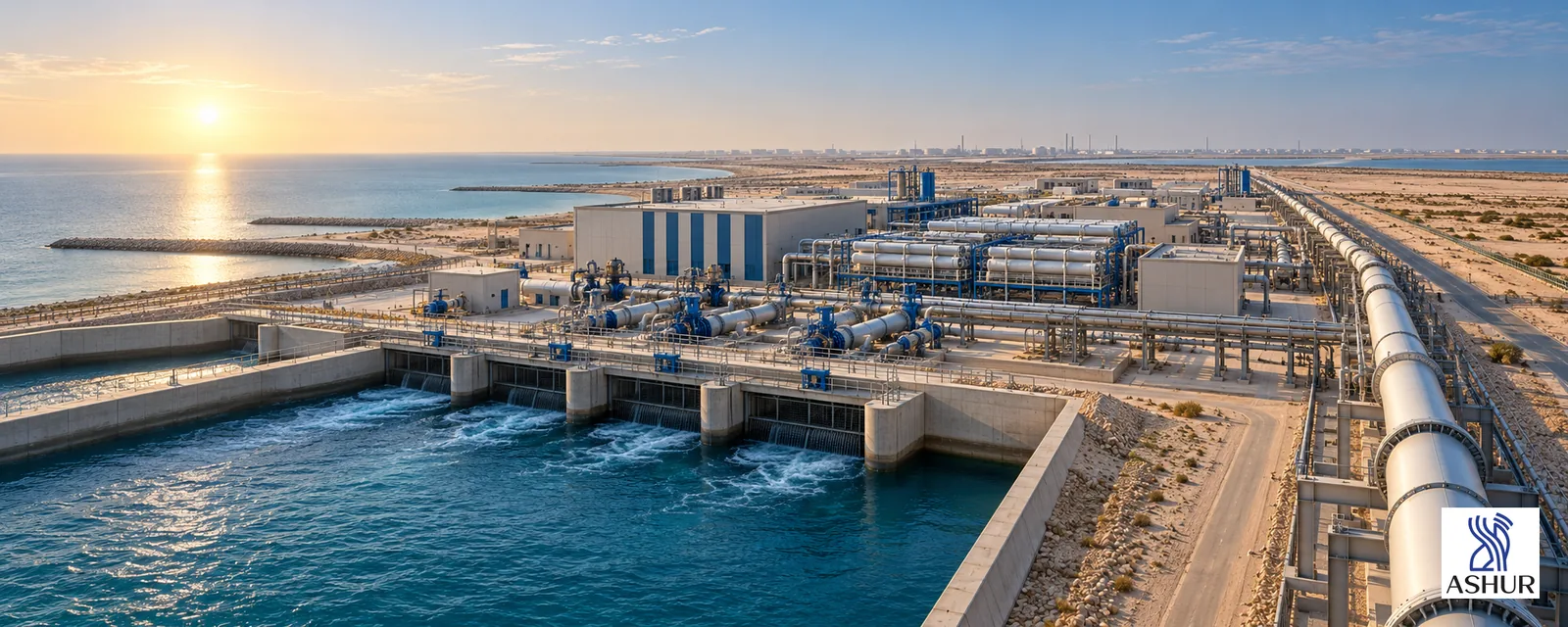
A useful way to understand a large seawater-supply system is as a connected engineering chain: marine intake and screening; treatment and water-quality management; high-capacity pumping and power; transmission pipelines; distribution interfaces; and field injection systems. This is an illustrative system model, not a published design for the ExxonMobil proposal.
The public TotalEnergies description confirms a coastal treatment facility near Um Qasr and transport to southern oilfields. Hyundai Engineering & Construction (Hyundai E&C) describes its Water Infrastructure Project as construction of a five-million-barrel-per-day treatment plant near Khor Al-Zubair. Public descriptions identify a pipeline network and field distribution as a separate major part of the CSSP. None of these disclosures establishes the intake location, treatment train, route, equipment specifications or injection interfaces for the proposed ExxonMobil phase.
In general, the design has to connect water chemistry and treatment objectives to the receiving reservoir and the operating envelope. Solids, biological growth, scaling, corrosion, pressure loss, pumping availability and pipeline integrity are common categories engineers assess. The appropriate controls are project- and reservoir-specific; a public MoU does not disclose them.
WHAT IS ALREADY CONTRACTED?
The existing CSSP has moved beyond announcement. Hyundai E&C states that it signed a contract on 14 September 2025 for the Water Infrastructure Project, including construction of the seawater treatment plant with a five-million-barrel-per-day capacity. TotalEnergies announced the start of construction the following day and described the CSSP as one of the final major GGIP contracts entering execution. Hyundai E&C contract announcement · TotalEnergies construction update
China Petroleum Pipeline Engineering (CPP) has publicly described its Iraq CSSP pipeline network as a separately contracted engineering, procurement, construction and commissioning (EPCC) project. The International Pipe Line & Offshore Contractors Association (IPLOCA), in member news, reported that the project formally began at the end of January 2026, with a stated duration of 54 months: 42 months for construction and 12 months for commissioning. It describes an approximately 949-kilometre network. IPLOCA update on the seawater pipeline network
These are existing CSSP scopes, not new ExxonMobil awards. Public announcements do not fully reconcile every contractual interface between the plant, pipeline and consortium arrangements, so this analysis does not infer those relationships beyond what the named parties have disclosed. No ExxonMobil second-phase EPC contractor or supplier award has been verified.
POTENTIAL SUPPLY-CHAIN IMPLICATIONS
As definition advances, monitor these potential capability areas; they are not evidence of an open tender or a specific procurement package.
Engineering and EPC. Process design, civil works, marine interfaces, power integration, installation and commissioning may be relevant. The proposed phase's scope and delivery model are unconfirmed.
Pipelines and mechanical systems. Networks may require pipe, valves, fittings, coatings and pumps. Suppliers must qualify products against actual specifications, origin rules and acceptance documents.
Electrical, instrumentation and control. These systems need power, monitoring and controls suited to the design; compatibility, documentation and service support matter alongside price.
Treatment materials and operations. Filtration, conditioning, monitoring and maintenance may be required. The proposal's treatment method and approved products are unpublished; no specific product list can be presumed.
Logistics and contractor readiness. Heavy or oversized cargo, shipping documents, port interfaces and inland movement require planning. Contractors should clarify importer responsibilities, customs status, workforce authorization and procurement qualification before committing resources. These are general considerations; no ASHUR or supplier appointment is implied.
Regulatory and contractor readiness. Local operating documentation, importer responsibilities, customs readiness, workforce authorization and buyer qualification may need to be established before mobilization; requirements depend on the actual award and operating model.
WHAT EVIDENCE WOULD MOVE THE PROPOSAL TOWARD EXECUTION?
An MoU records an agreed intention or framework; by itself, it does not answer who will invest, design, build, operate or supply the project. The next useful evidence would be a definitive commercial agreement; a disclosed scope and delivery model; engineering or FEED decisions; approved investment and implementation arrangements; verified procurement notices or awards; contractor mobilization; construction milestones; and, later, commissioning and measured operating delivery.
Illustrative confirmation gates: MoU → commercial and technical framework → engineering definition → investment and contract approval → procurement awards → construction → commissioning → verified operation.
These are observation gates, not a fixed sequence. A tender is not an award; an award is not completed construction; commissioning alone does not prove sustained throughput. Each status needs its own dated evidence.
EXECUTION CONSIDERATIONS
Shared water infrastructure creates interface risks as well as scale. Water quality must suit treatment objectives and field requirements; pumping and power must support planned rates; and long-distance pipelines need integrity, access and repair plans. Marine and environmental studies, construction logistics, land interfaces and operations also require project-specific treatment.
Injection volume and pressure must fit field plans, while treatment reliability and delivery availability must support them. These are general engineering considerations, not evidence of a problem at either Iraqi project. Public materials reviewed do not confirm the proposed phase's design, cost, route or schedule.
ASHUR EXECUTIVE OUTLOOK
The strategic significance is not simply a further 2.5 million barrels per day of proposed seawater capacity. It is the possibility of another integrated system intended to support pressure management across Iraq's oilfields, alongside a large CSSP already in execution. The commercial significance will depend on how the MoU develops into defined, financed, contracted and executed scope.
For the market, the disciplined approach is to separate the existing TotalEnergies project from the ExxonMobil proposal, monitor public milestones, and qualify suppliers and logistics plans against actual documents when they appear. Planned capacity is not an award, and an award is not delivered water.
ASHUR International | Iraq Energy Intelligence
Explore Oil & Gas Commercial Services, Procurement & Trading and Logistics & Freight Consultancy, or discuss a requirement. Email [email protected].