

ENERGY INTELLIGENCE · By ASHUR International
Q4 2026 archive · Original research cut-off: 8 October 2026, Baghdad (UTC+3). This edition preserves the practical assessment framework from that outlook. It is not a current tender list or a verified award pipeline.
Editorial review: 8 November 2026. The presentation has been clarified as a dated framework; the original research cut-off has not been advanced. Check current evidence before making a commercial commitment.
Federal Iraq Evidence Watch
A project phase alone does not establish an accessible award or physical mobilisation.
- ExplorationGeoscience and seismic work.
- AppraisalWells and tests.
- DevelopmentField-development plan and facilities.
- ProcurementInvitation to bid and evaluation.
- MobilisationRigs and logistics.
- ExecutionVerified milestones.
Validate each transition against an attributable notice, award, rig mobilisation or confirmed activity. This is a conceptual framework. Phases can overlap, repeat, pause or progress differently across fields.
View original artwork
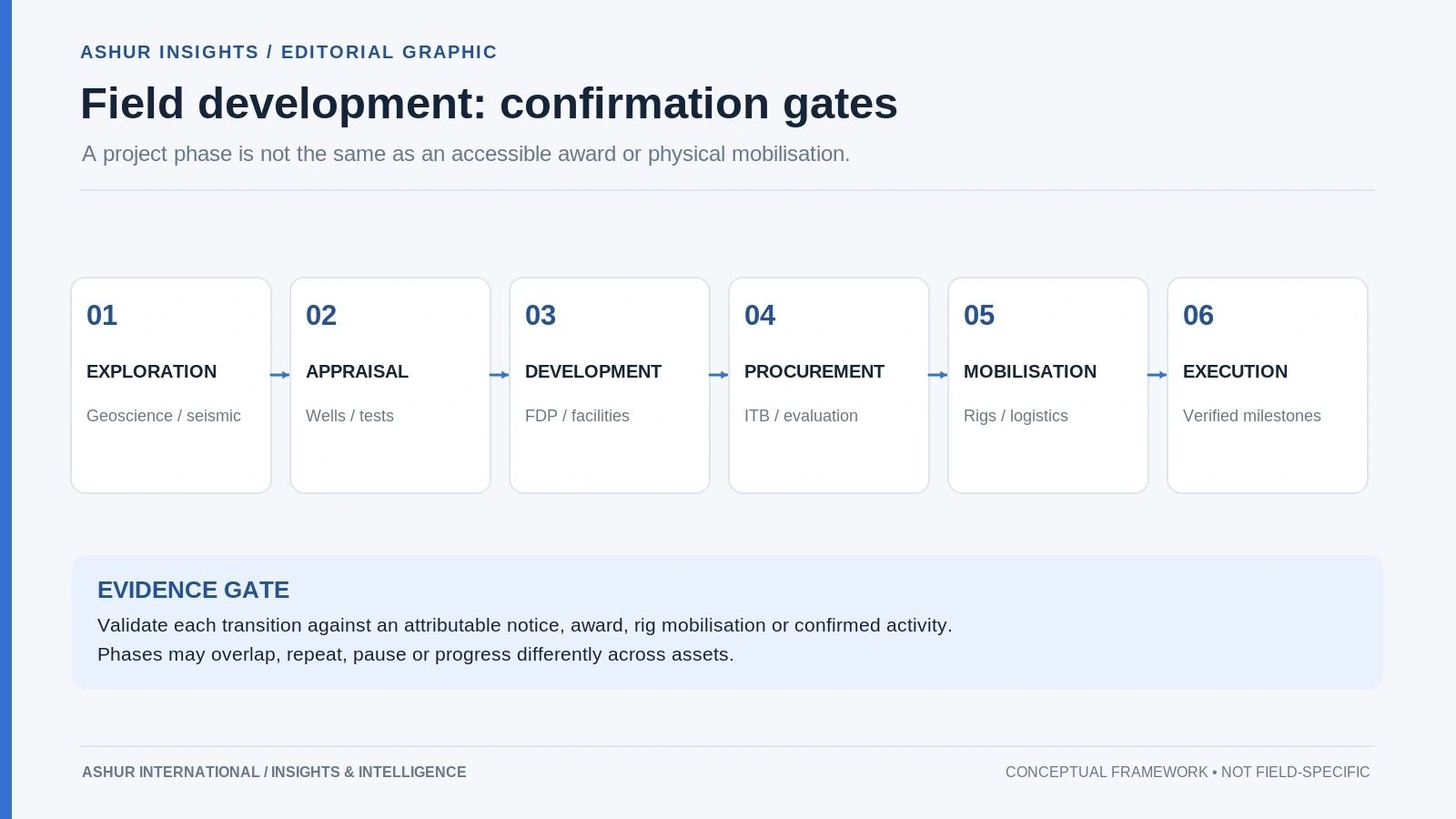
Exploration, appraisal, development, procurement, mobilisation and execution each require evidence.
A monitoring framework for Q4 2026 contractor and procurement intelligence.
- 30 days · Verify and qualifyCheck the current invitation to bid and amendments, bidder readiness, technical fit and deadline.
- 60 days · Link signals to executionReview award evidence, site readiness and links to mobilisation.
- 90 days · Reassess the pictureReview schedule changes, supplier capacity and matters awaiting confirmation.
These are illustrative planning intervals. Actual award or mobilisation dates require separate evidence.
View original artwork
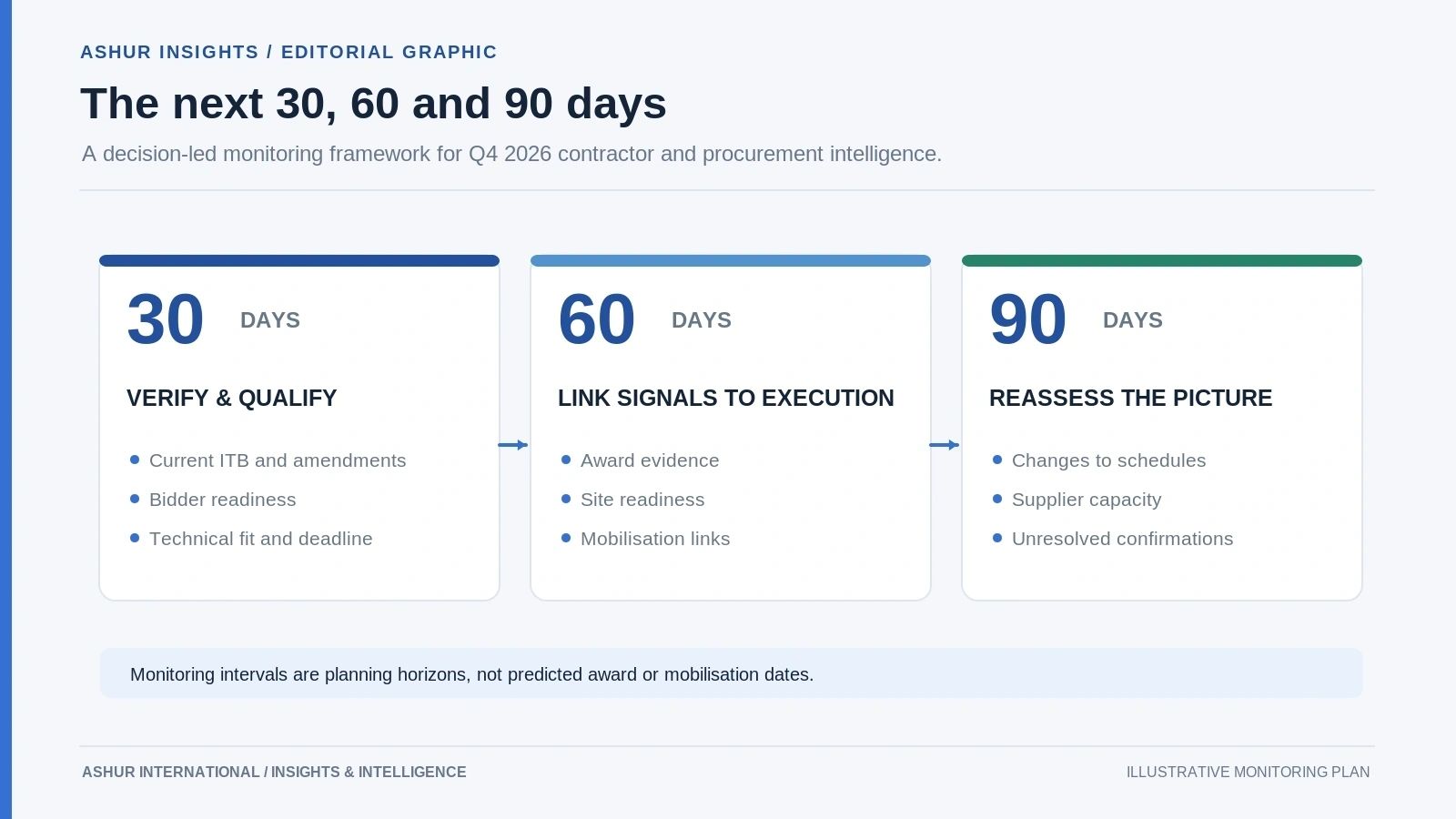
30 days: verify and qualify. 60 days: link signals to execution. 90 days: reassess the evidence. These are monitoring intervals.
Executive summary
For a contractor or supplier assessing Federal Iraq, the useful question is not simply whether a field is being developed. It is which requirement has reached a documented decision point, who is responsible for it and what evidence is still missing.
This Q4 framework separates project context, procurement, award and execution. Use it to qualify a requirement, prepare a supplier file and decide what needs verification before committing people, inventory or a delivery date. It does not rank current contractor awards or forecast project expenditure.
Qualify the package before the opportunity
Begin with the actual requirement rather than a broad project announcement. Three common categories need different questions:
- Oilfield equipment: What equipment is specified, which technical documents are requested and what establishes the buyer’s acceptance requirements?
- Pipeline materials: What materials, dimensions, specifications and delivery interfaces define the package? A materials enquiry alone does not establish a construction award.
- Power and surface infrastructure: What is included in the package, and which design, supply, installation or commissioning responsibilities sit elsewhere?
Check current amendments and bidder clarifications before acting. An invitation establishes a procurement stage; award, mobilisation and completion each need separate confirmation.
What would strengthen the evidence?
A development announcement establishes what was announced. A procurement notice adds a defined request. An award identifies a contracting decision within its stated scope. Mobilisation and operational progress require their own dated evidence.
For each assessment, record the underlying event date, source publication date and the date you reviewed it. Keep the next confirmation point explicit: a defined package, a documented award, site readiness or an operational milestone.
Also record evidence that could change the assessment, such as revised schedules, cancellations or a later reduction in scope. Several related announcements are not automatically several separate opportunities.
Drilling and workover: verify the route to a package
For operators and international contractors, the immediate task is to distinguish a development programme from an accessible contract opportunity. Check whether the buyer intends an integrated drilling package, individual rigs, workover services or separate technical services. Establish the actual procurement entity and eligibility requirements.
A historical contractor reference is context, not confirmation of a current award. Establish the buyer and the specific package before assigning a winner, rig count or start date.
Keep such market developments on a verification watchlist. Seek current attributable evidence before attaching a scope, winner, rig count or start date to a commercial assessment.
Well services and materials
For wellheads, fluids, cementing, logging, testing, intervention, manpower and waste handling, verify an actual requirement before treating a service category as live demand.
Prepare the supplier record around technical fit: specifications, manufacturer documentation, origin, inspection requirements, product traceability and delivery responsibility. SDS and TDS are relevant where the product and scope require them. Do not infer a manufacturer authorisation or technical approval from general market presence.
For an emerging project, identify what must be confirmed next: the buyer, applicable specification, procurement route and delivery window. Qualify an uncertain demand before committing inventory or promising delivery.
EPC, pipelines and infrastructure
Assess pipeline materials, wellhead equipment, power and associated infrastructure as separate scopes. Similar timing does not establish that they belong to one contractor or mobilisation programme.
Use a wider project announcement to understand context, then identify the package boundary and interfaces. Distinguish engineering, supply, construction and operations so that a requirement in one area is not presented as an award across all four.
Contractor and operator-transition risk
Track the contracting legal entity as carefully as the project name. Operator, affiliate, integrated contractor and supplier are different roles. A company’s involvement in one package does not establish that it controls another. Any tender restriction concerning affiliates, joint bidding or conflicts must be read in the current instrument.
Operator and contracting structures can change across regions and projects. Public historical announcements may provide context, but they do not establish a new drilling or EPC award. Verify the current legal entity, procurement route and delivery requirements before acting.
When an operator or contracting structure changes, verify continuity of procurement registrations, contract obligations, site access and documentary requirements. Do not infer withdrawal, replacement or a contract transfer from recruitment or supplier activity alone.
Procurement and regulatory readiness
Commercial readiness includes the records needed to participate, contract and deliver. Confirm the bidder’s registration status, applicable tax documentation, payroll and social-security position, authority correspondence and product or shipping records relevant to the requirement.
A headline provides context. The applicable procurement documents and current buyer instructions determine the participation process. Check registration and buyer-confirmation requirements against that specific process.
Tax and clearance questions depend on the entity, activity and actual tender instructions. Coordinate finance and commercial teams early enough to identify historical gaps. Do not assume that one certificate establishes universal eligibility or that a prior buyer’s acceptance carries forward.
The next 30, 60 and 90 days
Within 30 days: verify and qualify
Recheck broad market updates, amendments and qualification requirements. Review technical fit and documentary readiness, and seek current attributable evidence before treating any project or package as an active opportunity.
Within 60 days: connect packages to execution evidence
Monitor attributable award announcements, site-readiness records and project-specific mobilisation disclosures. Reconcile them to the original tender rather than counting each update as another opportunity. Revise the watchlist when a package is cancelled, deferred or awarded.
Within 90 days: reassess the operating picture
Check whether the expected confirmation points have appeared. Preserve unanswered questions where they have not. Review delivery dependencies, supplier qualification and the documentary position of any live engagement. Update conclusions visibly, with a new cut-off and a reason for material changes.
The six-to-twelve-month planning view
The useful planning themes are development preparation at emerging fields, well construction and intervention, surface facilities, power and pipeline infrastructure, and the local services needed to support execution. Use these as planning categories, not guaranteed demand, a project budget or a forecast award calendar.
Build scenarios around confirmation triggers: a published package, a named award, a documented mobilisation and a verified operational milestone. Assess supplier capacity and logistics against each scenario without assigning private probabilities or unverified contract values. Revisit the scenarios as public evidence changes.
Evidence, coverage and limitations
This archived edition is a method for assessing opportunities, not a source register or a list of currently available contracts. No company-specific opportunity, award or delivery claim is made here.
For a live assessment, use attributable, publication-permitted evidence and record its date and scope. Absence of public confirmation is an unresolved question, not proof of inactivity. Keep commercial assumptions separate from facts that a reader can verify.
For current public research, open ASHUR Intelligence or browse ASHUR Insights. Check each item’s own evidence and review date.
From market signal to a documented requirement
ASHUR International connects public-source market analysis with Iraq commercial and compliance considerations. A briefing can focus on the project, package or operating decision that matters to your team, with evidence, uncertainty and the next confirmation point kept explicit.
Related services and reading
Oil & Gas Commercial Services · Strategic Procurement & Trading · Oilfield Materials & Chemicals · Tax & Tax Controversy
Disclaimer. This dated framework is general information, not a current procurement instruction or confirmation of an award. Evidence and commercial conditions may change; verify the actual requirement before acting.