

A historical corporate-tax claim requires a position that can be explained, supported and carried through the relevant review. For an international contractor operating in Iraq, the assignment described here combined historical accounting and tax review, technical reconciliation, supporting submissions and engagement with the tax authority. The full later-audit claim procedure was successfully completed.
This account draws on reviewed historical records and professional experience confirmed by ASHUR’s founder. Client identity and identifying details have been withheld. It focuses on the work required to substantiate the position and bring the procedure to completion.
The matter requiring attention
The contractor maintained its historical accounting position and sought review of a corporate-tax claim through a later-audit process. The practical task was to put the position before the reviewing authority with records and explanations capable of being examined.
“Later audit” describes the review process in the historical material. This experience account concerns that assignment; it does not set out the procedure available to every taxpayer today.
The relevant periods, project, amounts and authority references remain confidential. What can be described is the substance of the review: accounting records, supporting schedules and documents were brought together so that the historical position could be examined on its evidence.
Bringing the position back to the records
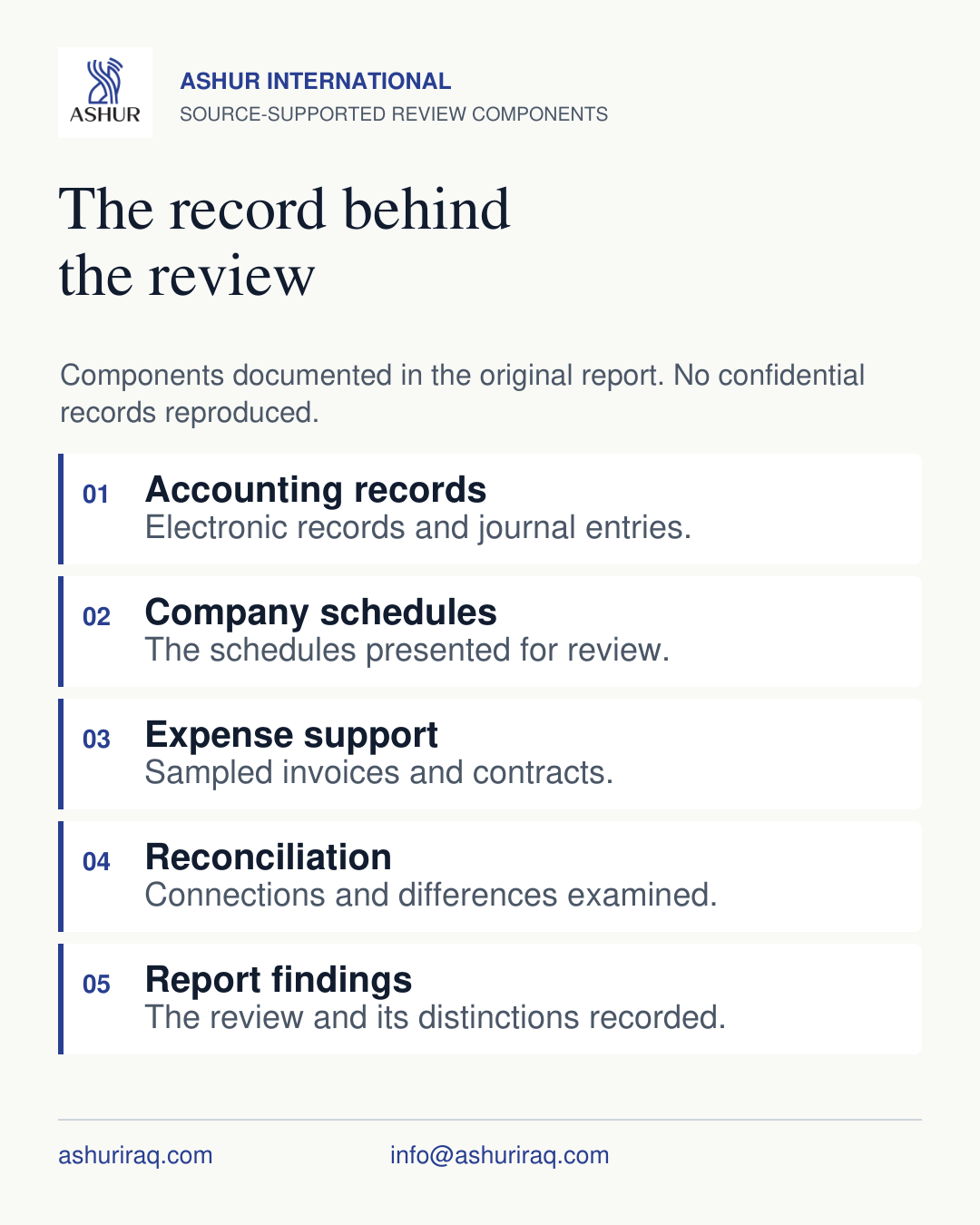
The historical review record describes examination of electronic accounting records, including journal entries and account classifications. It also records the transfer of requested material with an acknowledged receipt. This establishes a documentary connection between the records made available and the review that followed.
The reviewing authority sampled expense-supporting documents and compared them with company schedules. Invoices and contracts formed part of the material reviewed. The record distinguished documented support from items requiring adjustment or further evidence; it did not treat the presence of a schedule as proof of every entry within it.
These were review activities recorded by the authority. They are not presented as actions personally performed by the founder. The practitioner’s confirmed work concerned historical accounting and tax review, technical reconciliation, supporting submissions and authority engagement.
The distinction between a record and its explanation was important. Accounting records provided the financial detail. Reconciliation schedules connected relevant components of the position. Supporting submissions put the technical explanation before the reviewer. The relationship between the accounting record and the review schedules had to remain clear as the position was explained.
The public account describes these supported elements without turning them into a precise chronology. The accompanying graphic summarizes what the original report examined. It is not a reconstruction of every exchange in the client’s file.
Read the text equivalent
ASHUR INTERNATIONAL SOURCE-SUPPORTED REVIEW COMPONENTS ashuriraq.com [email protected] The record behind the review Components documented in the original report. No confidential records reproduced. 01 Accounting records Electronic records and journal entries. 02 Company schedules The schedules presented for review. 03 Expense support Sampled invoices and contracts. 04 Reconciliation Connections and differences examined. 05 Report findings The review and its distinctions recorded.
SOURCE-SUPPORTED. What the original review report examined; it does not attribute the authority’s work to the practitioner.
Submissions and procedural management
Supporting submissions and engagement with the tax authority formed the procedural side of the assignment. The historical material records review documentation, reconciliation schedules and internal authority correspondence. The work therefore extended beyond an internal accounting analysis, into an actual review process.
Documentary control matters in that setting. A record of material transferred can establish what was made available. A schedule can show how a position was reconciled. A later communication can raise or address a particular question. Each has a different evidentiary purpose; none should be silently promoted into proof of a wider outcome.
The practitioner’s preparation and coordination supported the process, while the authority undertook its examination and internal handling of the matter. Keeping these responsibilities distinct gives an accurate account of the professional contribution without appropriating the authority’s actions.
The supported conclusion
The full historical corporate-tax claim and later-audit procedure was successfully completed. This is the outcome confirmed by ASHUR’s founder.
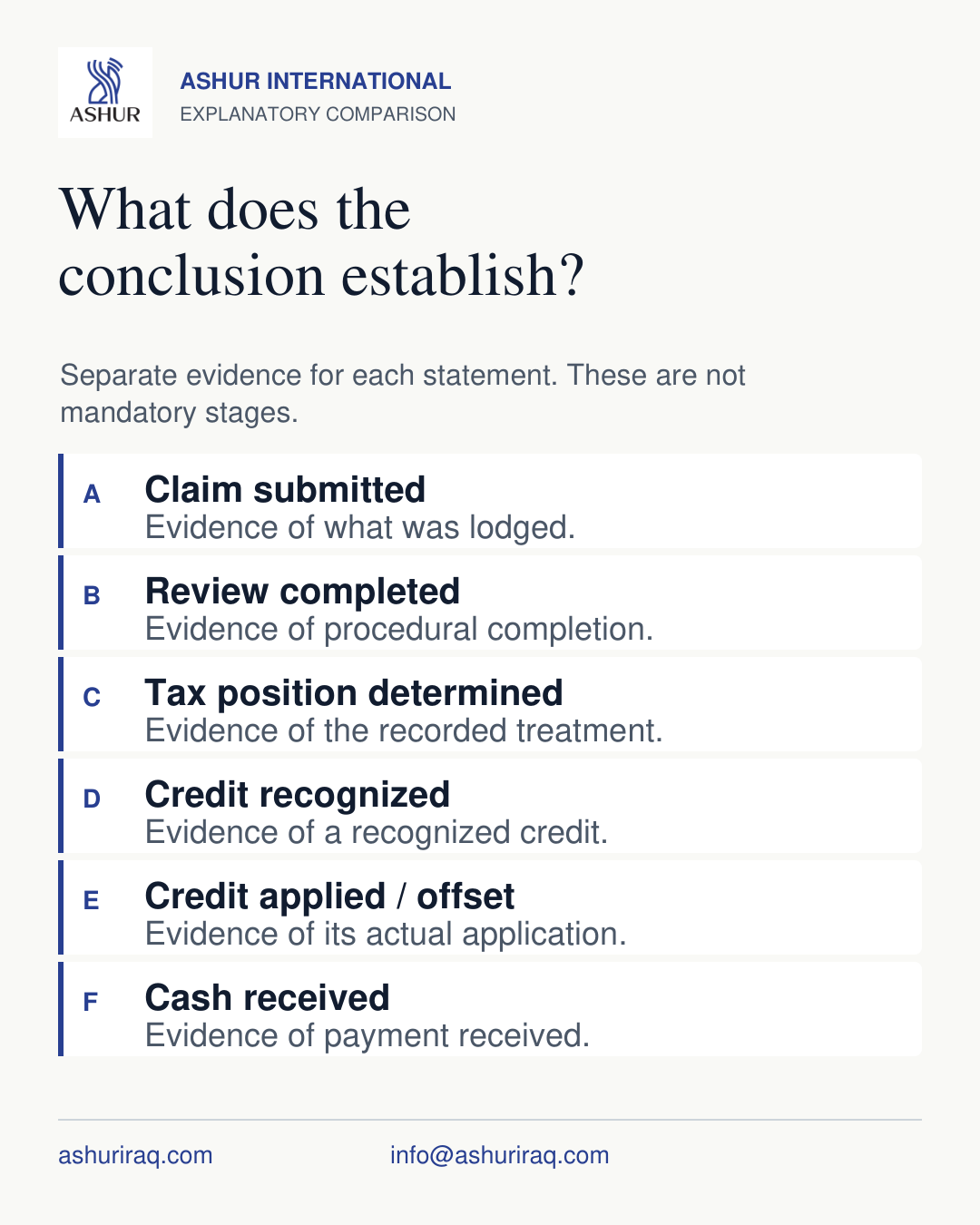
The completion statement is not used to imply a particular tax saving, recognized credit, offset or cash receipt. Those are separate conclusions requiring their own evidence, and financial results are outside this anonymous account.
The accompanying comparison explains these distinctions. They are possible documentary states, not a mandatory sequence or a list of outcomes claimed for the engagement.
Read the text equivalent
ASHUR INTERNATIONAL EXPLANATORY COMPARISON ashuriraq.com [email protected] What does the conclusion establish? Separate evidence for each statement. These are not mandatory stages. A Claim submitted Evidence of what was lodged. B Review completed Evidence of procedural completion. C Tax position determined Evidence of the recorded treatment. D Credit recognized Evidence of a recognized credit. E Credit applied / offset Evidence of its actual application. F Cash received Evidence of payment received.
GENERAL FRAMEWORK. An explanatory comparison, not mandatory stages or results claimed for this case.
What finance leaders can take from the experience
The following observations are general professional lessons, separate from the historical facts above.
Define the position before enlarging the file. A useful review starts with the question that needs to be answered. Collecting documents becomes more effective when each record has an identifiable purpose in the analysis.
Make the reconciliation explainable. A reviewer should be able to follow a conclusion to the relevant schedule and then to its supporting record. Where a difference remains unexplained, keep it visible rather than turning an assumption into a settled fact.
Keep the submitted version identifiable. Internal working material and the version actually submitted may serve different purposes. Maintaining a clear record of what was presented helps the team respond consistently and understand later correspondence.
Describe the result at the level the evidence supports. Management reporting is more useful when it names the completed procedure and separately records any documented financial treatment. A broad success statement should never conceal which questions have actually been resolved.
A focused starting point for a historical tax matter
ASHUR’s current tax and tax-controversy services include historical accounting review, reconciliation, technical response preparation and authorized authority coordination within an agreed scope. A first discussion can establish the broad corporate-tax issue, the procedural position and the records available for review.
For the wider distinction between filing, assessment and finality, read Filed Is Not Final. For the separate question of tax-status documents in commercial requirements, see NOL is Not Just a Certificate.
Explore Tax & Tax Controversy or discuss a historical corporate-tax requirement. Please share only the broad issue in the initial enquiry; confidential records can be addressed through an agreed review process.