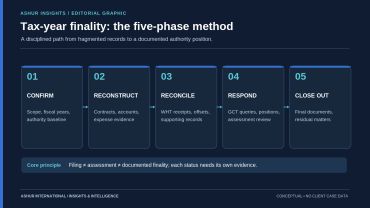
What Iraq’s evolving self-assessment regime means for companies carrying multiple open fiscal years — and why oil and gas contractors should review their historical tax positions now.
For companies operating in Iraq, meeting the requirements of annual financial statements, fulfilling oil and gas tax compliance, and obtaining necessary documentation for continued business can lead to a common assumption: the tax year has been completed.
However, this assumption increasingly requires reconsideration.
Iraq’s tax reforms have aimed to streamline annual tax compliance processes, making them faster and more practical. The authorities are shifting towards a greater reliance on taxpayer financial statements and self-assessment, along with accelerated tax accounting, rather than mandating a comprehensive examination of every aspect of a company’s accounts before routine commercial activities can proceed.
An important distinction lies at the heart of this system:
A fiscal year can be filed and tax-accounted without necessarily being fully audited and closed.
For businesses managing several such years, especially international oil and gas companies and contractors, subsequent tax audits — often termed “later audit” — have become vital. This process allows for the evaluation, defense, reconciliation, and resolution of historical tax positions.
Recent developments from the Iraqi Council of Ministers, the Ministry of Finance, and the General Commission for Taxes (GCT) suggest that this distinction is gaining significance. Historical tax positions are increasingly linked to collections, tax clearance processes, government dealings, and, particularly in the oil sector, the Ministry of Oil itself.
It is important to establish the history correctly.
Self-assessment for Iraq’s Large Taxpayer segment predates the recent Iraq tax reforms. The GCT has publicly stated that the approach was adopted for Large Taxpayers pursuant to a Ministry of Finance decision in 2014. The categories expressly included foreign companies holding oil licensing-round contracts and certain foreign subcontractors performing qualifying activities related to oil and gas tax compliance.
What changed significantly in the following years was the extent to which the government used this mechanism to facilitate faster tax accounting and reduce administrative bottlenecks.
A major step came with Cabinet Decision No. 23527 of 2023. The decision accepted accounts and financial statements audited by authorized professionals and provided for tax to be paid based on those financial statements, while also establishing a mechanism for the accounts to be audited subsequently by the relevant authorities, leading to potential subsequent tax audits.
The distinction is fundamental.
The reform accelerated the front end of the tax process, but it did not eliminate the back end.
In implementing GCT correspondence reviewed by ASHUR, the position is expressed particularly clearly: the resulting assessment is described as non-final and subject to the results of examination and audit, while the taxpayer’s accounts remain subject to subsequent review.
The practical model can therefore be understood as:
financial statements → initial tax accounting → payment/administrative processing → continued commercial activity → subsequent examination and audit → reconciliation and finalization.
This is very different from assuming that payment following submission of the annual accounts automatically means the historical fiscal year can never be revisited.
Iraq’s Income Tax Law retains significant authority for the tax administration to examine taxpayer positions, particularly in light of recent Iraq tax reforms aimed at enhancing compliance measures.
Article 30 of Income Tax Law No. 113 of 1982 permits the financial authority, after reviewing a taxpayer’s return, to either accept it and assess taxes accordingly, or to reject it and evaluate income based on the information at hand. Article 28 further equips the tax administration with powers related to information acquisition, halting certain tax-related transactions, and requiring amounts to be withheld from payments to contractors until tax clearance is confirmed, which is crucial for oil and gas tax compliance.
Current professional guidance aligns with this approach. PwC’s Iraq tax administration summary, last reviewed on 24 June 2026, emphasizes that tax inspection is mandatory, and that the GCT meticulously scrutinizes financial statements to determine tax liability and issue tax clearance. Additionally, PwC notes that obtaining tax clearance through tax audits or inspections is increasingly essential for government bidding, importation, and other matters that affect the continuation of operations.
This clarity prompts a crucial distinction that management teams should incorporate into their tax governance: filing status and final tax status are not necessarily the same.
A company may legitimately assert:
“We submitted our 2023 tax accounts.”
However, this does not inherently address the question:
“Has 2023 been fully examined and finally resolved?”
This distinction grows more significant as the number of unresolved years and their corresponding value increases, particularly in light of potential subsequent tax audits.
The issue has greater significance in industries where individual contracts are large, especially in the context of Iraq tax reforms, as withholding positions are material and government interfaces are frequent.
International oil companies, drilling contractors, oilfield service companies, EPC contractors, and specialist subcontractors may carry significant historical positions involving contract revenue, withholding taxes, payroll, deductible expenses, imported equipment, intercompany charges, branch expenses, fixed assets, prior-year losses, and tax deposits. This complexity underscores the necessity for oil and gas tax compliance.
A later examination may therefore require much more than simply reproducing the tax return originally submitted, particularly in light of potential subsequent tax audits.
The taxpayer may need to reconstruct the underlying position and demonstrate how the historical figures were derived. This can involve reconciling commercial contracts to accounting records, tracing tax withheld by customers, substantiating expenses, reviewing payroll and personnel records, reconciling tax deposits and prior payments, supporting loss positions, and explaining differences between audited financial statements, management accounts, and tax computations.
The longer the period between the original transaction and the eventual examination, the more difficult this exercise can become. Employees leave, accounting systems change, project offices close, old subcontractors become difficult to locate, and supporting documents become fragmented.
The issue is therefore not simply whether a company will eventually undergo a subsequent audit. It is whether, when that audit arrives, the company can still defend the historical position efficiently and with sufficient evidence.
Government policy regarding historical tax matters in the oil sector became particularly visible in 2025, highlighting ongoing Iraq tax reforms.
In February 2025, formal Prime Minister’s Office instructions offered International Oil Companies more payment flexibility and relief from penalties and interest related to historical assessments, specifically aimed at promoting the resolution of accumulated tax matters. This initiative is part of broader efforts to enhance oil and gas tax compliance in the sector.
The process was subsequently extended; in May 2025, an additional 45 working days was granted for IOCs and the GCT to continue their efforts toward resolving historical assessments, pushing the relevant period into July 2025. Deloitte reported that discussions involved not only the GCT but also the Ministry of Oil, the Prime Minister’s Office, international oil companies, and their advisers.
The significance of these measures extends beyond the temporary concessions, as they illustrate a government policy preference for resolving historical tax positions rather than allowing unresolved assessment years to remain outstanding, which could eventually trigger subsequent tax audits.
Developments during 2026 suggest that Iraq tax reforms, particularly in tax assessment and historical compliance, remain active priorities for reform.
On 4 February 2026, the Prime Minister chaired a meeting of the Higher Committee for Tax Reform, which included senior officials from the GCT. The meeting focused on unifying tax-assessment procedures, addressing oil and gas tax compliance issues facing companies, and discussing measures to encourage taxpayers to regularise their financial and legal positions, alongside a proposed Tax Assessment Law.
This provides important context.
The Iraqi tax framework is dynamic. Tax assessment procedures are under continuous review, with the government striving to enhance the business environment while boosting non-oil state revenue. Consequently, businesses must evaluate their historical tax positions not only in light of past practices but also in relation to the evolving direction of the system, especially considering the implications of subsequent tax audits.
A major development occurred on 29 June 2026. The Iraqi Council of Ministers approved a recommendation concerning tax accounting for foreign oil companies operating in Iraq, including contractors, as part of ongoing Iraq tax reforms. Of particular importance, the Cabinet directed the GCT to provide the Ministry of Oil with detailed lists of foreign companies, branches, offices, and contractors carrying outstanding income tax, additional amounts, or other unpaid tax obligations for purposes of collection. For the oil and gas sector, this materially changes how historical tax exposure should be viewed in the context of oil and gas tax compliance. Tax compliance cannot simply be considered an accounting-department matter where unresolved balances remain confined to a GCT file. The emerging framework creates a direct institutional connection between the taxpayer, GCT, and the Ministry of Oil. Where outstanding liabilities are involved, a tax matter may therefore become relevant to the broader relationship between a contractor and the Iraqi oil-sector authorities. This reinforces a point that ASHUR considers increasingly important: For an oil and gas contractor, historical tax exposure can become operational exposure, especially in light of subsequent tax audits. Tax position, government contracting, payment flows, and continuity of business should no longer be managed as entirely separate subjects.
The direction for Iraq's tax reforms became clearer again in August. On 17 August 2026, the Ministry of Finance and Federal Board of Supreme Audit announced an agreement aimed at addressing delays in tax accounting and specifically tackling the accumulation of years for which tax accounting had not been completed. For the categories covered by this arrangement, GCT could collect tax once financial statements were submitted, without waiting for the completion of the final audit, while subsequent tax audits and financial-control procedures would continue separately. The authorities also emphasised legal action against entities that delayed or refused to submit their accounts. The announcement concerned entities subject to Federal Board of Supreme Audit procedures and should not be automatically interpreted as a specific rule for every foreign oil contractor. Its policy significance, however, is clear. Iraq continues to distinguish between accelerating tax accounting today and continuing the audit process afterwards. The Ministry of Finance is simultaneously identifying accumulated unresolved years as a problem requiring action, which is highly relevant to companies that may have several fiscal periods already filed but not yet fully examined in terms of oil and gas tax compliance.
The worst time for a company to begin reconstructing five years of tax history is after receiving a formal examination notice, particularly in the context of upcoming Iraq tax reforms. A better approach is to identify open years in advance and assess what would happen if the authorities called those years for subsequent tax audits tomorrow.
Management should be able to answer a relatively simple set of questions:
Which fiscal years have only been filed or provisionally tax-accounted, and which have actually been examined and finalized?
Can revenue be reconciled from the contracts through the financial statements and tax computation?
Can all material expenses still be substantiated?
Are withholding-tax deductions and tax deposits fully reconciled and supported?
Are historical payroll, PIT, and social-security positions consistent with the accounting records?
Can carried-forward losses and prior-year adjustments withstand examination, especially in light of oil and gas tax compliance requirements?
Are intercompany, head-office, and foreign-currency transactions adequately documented?
Does the company understand the potential difference between its declared position and the exposure that could arise under an administrative assessment?
The objective is not to reopen tax positions unnecessarily. Instead, the goal is to know whether the company can defend them before someone else decides to open them.
There is a tendency to view a later audit as a retrospective burden — something relating exclusively to old accounting records. That understates its strategic value. A properly managed subsequent tax audit can establish certainty over historical tax years, reconcile legitimate tax credits and withholding positions, support losses brought forward, resolve disputes over historical assessments, and provide management with a clearer understanding of the company’s actual Iraqi tax exposure in light of Iraq tax reforms. This proactive approach is particularly crucial for oil and gas tax compliance, as it can also prevent an uncertain historical position from appearing at the least convenient time: during a major tender, government payment, restructuring, contract close-out, or expansion of operations. For companies contemplating long-term participation in Iraq, historical tax certainty should therefore be treated as part of forward-looking corporate governance.
ASHUR’s view of subsequent tax audits is informed by direct execution experience.
ASHUR has successfully supported the resolution and closure of a significant historical tax claim involving an international oil & gas contractor operating in Iraq, achieving a highly favourable outcome through detailed examination of historical fiscal years, technical tax analysis, reconciliation of the underlying position, documentary substantiation and management of the assessment process.
This experience reinforces an important principle:
Historical tax claims are rarely resolved by looking at one tax return in isolation.
Successful resolution, particularly in the context of Iraq tax reforms and oil and gas tax compliance, requires understanding the complete relationship between the company’s contracts, accounting records, statutory financial statements, withholding positions, prior tax payments, correspondence with the authorities, and the applicable Iraqi tax framework.
That same discipline should be applied before accumulated self-assessed years develop into a dispute.
ASHUR KINGS LLC offers comprehensive corporate and tax advisory services, including accounting, statutory compliance, social-security and payroll management, corporate structuring, and specialized support for international companies operating in Iraq, particularly those in the oil and gas sector. With the ongoing Iraq tax reforms, ASHUR KINGS is well-positioned to assist companies in achieving oil and gas tax compliance to navigate their fiscal responsibilities effectively. For businesses looking to assess historical fiscal years, prepare for subsequent tax audits, or address complex Iraqi tax positions, ASHUR provides an integrated solution that combines technical tax analysis, financial reconstruction, and local execution. This article is for informational purposes only and does not provide legal or tax advice. The application of Iraqi tax laws and administrative procedures varies based on the specific facts and circumstances of each taxpayer.

What Iraq’s evolving self-assessment regime means for companies carrying multiple open fiscal years — and why oil and gas contractors should review their historical tax positions now.
For companies operating in Iraq, meeting the requirements of annual financial statements, fulfilling oil and gas tax compliance, and obtaining necessary documentation for continued business can lead to a common assumption: the tax year has been completed.
However, this assumption increasingly requires reconsideration.
Iraq’s tax reforms have aimed to streamline annual tax compliance processes, making them faster and more practical. The authorities are shifting towards a greater reliance on taxpayer financial statements and self-assessment, along with accelerated tax accounting, rather than mandating a comprehensive examination of every aspect of a company’s accounts before routine commercial activities can proceed.
An important distinction lies at the heart of this system:
A fiscal year can be filed and tax-accounted without necessarily being fully audited and closed.
For businesses managing several such years, especially international oil and gas companies and contractors, subsequent tax audits — often termed “later audit” — have become vital. This process allows for the evaluation, defense, reconciliation, and resolution of historical tax positions.
Recent developments from the Iraqi Council of Ministers, the Ministry of Finance, and the General Commission for Taxes (GCT) suggest that this distinction is gaining significance. Historical tax positions are increasingly linked to collections, tax clearance processes, government dealings, and, particularly in the oil sector, the Ministry of Oil itself.
It is important to establish the history correctly.
Self-assessment for Iraq’s Large Taxpayer segment predates the recent Iraq tax reforms. The GCT has publicly stated that the approach was adopted for Large Taxpayers pursuant to a Ministry of Finance decision in 2014. The categories expressly included foreign companies holding oil licensing-round contracts and certain foreign subcontractors performing qualifying activities related to oil and gas tax compliance.
What changed significantly in the following years was the extent to which the government used this mechanism to facilitate faster tax accounting and reduce administrative bottlenecks.
A major step came with Cabinet Decision No. 23527 of 2023. The decision accepted accounts and financial statements audited by authorized professionals and provided for tax to be paid based on those financial statements, while also establishing a mechanism for the accounts to be audited subsequently by the relevant authorities, leading to potential subsequent tax audits.
The distinction is fundamental.
The reform accelerated the front end of the tax process, but it did not eliminate the back end.
In implementing GCT correspondence reviewed by ASHUR, the position is expressed particularly clearly: the resulting assessment is described as non-final and subject to the results of examination and audit, while the taxpayer’s accounts remain subject to subsequent review.
The practical model can therefore be understood as:
financial statements → initial tax accounting → payment/administrative processing → continued commercial activity → subsequent examination and audit → reconciliation and finalization.
This is very different from assuming that payment following submission of the annual accounts automatically means the historical fiscal year can never be revisited.
Iraq’s Income Tax Law retains significant authority for the tax administration to examine taxpayer positions, particularly in light of recent Iraq tax reforms aimed at enhancing compliance measures.
Article 30 of Income Tax Law No. 113 of 1982 permits the financial authority, after reviewing a taxpayer’s return, to either accept it and assess taxes accordingly, or to reject it and evaluate income based on the information at hand. Article 28 further equips the tax administration with powers related to information acquisition, halting certain tax-related transactions, and requiring amounts to be withheld from payments to contractors until tax clearance is confirmed, which is crucial for oil and gas tax compliance.
Current professional guidance aligns with this approach. PwC’s Iraq tax administration summary, last reviewed on 24 June 2026, emphasizes that tax inspection is mandatory, and that the GCT meticulously scrutinizes financial statements to determine tax liability and issue tax clearance. Additionally, PwC notes that obtaining tax clearance through tax audits or inspections is increasingly essential for government bidding, importation, and other matters that affect the continuation of operations.
This clarity prompts a crucial distinction that management teams should incorporate into their tax governance: filing status and final tax status are not necessarily the same.
A company may legitimately assert:
“We submitted our 2023 tax accounts.”
However, this does not inherently address the question:
“Has 2023 been fully examined and finally resolved?”
This distinction grows more significant as the number of unresolved years and their corresponding value increases, particularly in light of potential subsequent tax audits.
The issue has greater significance in industries where individual contracts are large, especially in the context of Iraq tax reforms, as withholding positions are material and government interfaces are frequent.
International oil companies, drilling contractors, oilfield service companies, EPC contractors, and specialist subcontractors may carry significant historical positions involving contract revenue, withholding taxes, payroll, deductible expenses, imported equipment, intercompany charges, branch expenses, fixed assets, prior-year losses, and tax deposits. This complexity underscores the necessity for oil and gas tax compliance.
A later examination may therefore require much more than simply reproducing the tax return originally submitted, particularly in light of potential subsequent tax audits.
The taxpayer may need to reconstruct the underlying position and demonstrate how the historical figures were derived. This can involve reconciling commercial contracts to accounting records, tracing tax withheld by customers, substantiating expenses, reviewing payroll and personnel records, reconciling tax deposits and prior payments, supporting loss positions, and explaining differences between audited financial statements, management accounts, and tax computations.
The longer the period between the original transaction and the eventual examination, the more difficult this exercise can become. Employees leave, accounting systems change, project offices close, old subcontractors become difficult to locate, and supporting documents become fragmented.
The issue is therefore not simply whether a company will eventually undergo a subsequent audit. It is whether, when that audit arrives, the company can still defend the historical position efficiently and with sufficient evidence.
Government policy regarding historical tax matters in the oil sector became particularly visible in 2025, highlighting ongoing Iraq tax reforms.
In February 2025, formal Prime Minister’s Office instructions offered International Oil Companies more payment flexibility and relief from penalties and interest related to historical assessments, specifically aimed at promoting the resolution of accumulated tax matters. This initiative is part of broader efforts to enhance oil and gas tax compliance in the sector.
The process was subsequently extended; in May 2025, an additional 45 working days was granted for IOCs and the GCT to continue their efforts toward resolving historical assessments, pushing the relevant period into July 2025. Deloitte reported that discussions involved not only the GCT but also the Ministry of Oil, the Prime Minister’s Office, international oil companies, and their advisers.
The significance of these measures extends beyond the temporary concessions, as they illustrate a government policy preference for resolving historical tax positions rather than allowing unresolved assessment years to remain outstanding, which could eventually trigger subsequent tax audits.
Developments during 2026 suggest that Iraq tax reforms, particularly in tax assessment and historical compliance, remain active priorities for reform.
On 4 February 2026, the Prime Minister chaired a meeting of the Higher Committee for Tax Reform, which included senior officials from the GCT. The meeting focused on unifying tax-assessment procedures, addressing oil and gas tax compliance issues facing companies, and discussing measures to encourage taxpayers to regularise their financial and legal positions, alongside a proposed Tax Assessment Law.
This provides important context.
The Iraqi tax framework is dynamic. Tax assessment procedures are under continuous review, with the government striving to enhance the business environment while boosting non-oil state revenue. Consequently, businesses must evaluate their historical tax positions not only in light of past practices but also in relation to the evolving direction of the system, especially considering the implications of subsequent tax audits.
A major development occurred on 29 June 2026. The Iraqi Council of Ministers approved a recommendation concerning tax accounting for foreign oil companies operating in Iraq, including contractors, as part of ongoing Iraq tax reforms. Of particular importance, the Cabinet directed the GCT to provide the Ministry of Oil with detailed lists of foreign companies, branches, offices, and contractors carrying outstanding income tax, additional amounts, or other unpaid tax obligations for purposes of collection. For the oil and gas sector, this materially changes how historical tax exposure should be viewed in the context of oil and gas tax compliance. Tax compliance cannot simply be considered an accounting-department matter where unresolved balances remain confined to a GCT file. The emerging framework creates a direct institutional connection between the taxpayer, GCT, and the Ministry of Oil. Where outstanding liabilities are involved, a tax matter may therefore become relevant to the broader relationship between a contractor and the Iraqi oil-sector authorities. This reinforces a point that ASHUR considers increasingly important: For an oil and gas contractor, historical tax exposure can become operational exposure, especially in light of subsequent tax audits. Tax position, government contracting, payment flows, and continuity of business should no longer be managed as entirely separate subjects.
The direction for Iraq's tax reforms became clearer again in August. On 17 August 2026, the Ministry of Finance and Federal Board of Supreme Audit announced an agreement aimed at addressing delays in tax accounting and specifically tackling the accumulation of years for which tax accounting had not been completed. For the categories covered by this arrangement, GCT could collect tax once financial statements were submitted, without waiting for the completion of the final audit, while subsequent tax audits and financial-control procedures would continue separately. The authorities also emphasised legal action against entities that delayed or refused to submit their accounts. The announcement concerned entities subject to Federal Board of Supreme Audit procedures and should not be automatically interpreted as a specific rule for every foreign oil contractor. Its policy significance, however, is clear. Iraq continues to distinguish between accelerating tax accounting today and continuing the audit process afterwards. The Ministry of Finance is simultaneously identifying accumulated unresolved years as a problem requiring action, which is highly relevant to companies that may have several fiscal periods already filed but not yet fully examined in terms of oil and gas tax compliance.
The worst time for a company to begin reconstructing five years of tax history is after receiving a formal examination notice, particularly in the context of upcoming Iraq tax reforms. A better approach is to identify open years in advance and assess what would happen if the authorities called those years for subsequent tax audits tomorrow.
Management should be able to answer a relatively simple set of questions:
Which fiscal years have only been filed or provisionally tax-accounted, and which have actually been examined and finalized?
Can revenue be reconciled from the contracts through the financial statements and tax computation?
Can all material expenses still be substantiated?
Are withholding-tax deductions and tax deposits fully reconciled and supported?
Are historical payroll, PIT, and social-security positions consistent with the accounting records?
Can carried-forward losses and prior-year adjustments withstand examination, especially in light of oil and gas tax compliance requirements?
Are intercompany, head-office, and foreign-currency transactions adequately documented?
Does the company understand the potential difference between its declared position and the exposure that could arise under an administrative assessment?
The objective is not to reopen tax positions unnecessarily. Instead, the goal is to know whether the company can defend them before someone else decides to open them.
There is a tendency to view a later audit as a retrospective burden — something relating exclusively to old accounting records. That understates its strategic value. A properly managed subsequent tax audit can establish certainty over historical tax years, reconcile legitimate tax credits and withholding positions, support losses brought forward, resolve disputes over historical assessments, and provide management with a clearer understanding of the company’s actual Iraqi tax exposure in light of Iraq tax reforms. This proactive approach is particularly crucial for oil and gas tax compliance, as it can also prevent an uncertain historical position from appearing at the least convenient time: during a major tender, government payment, restructuring, contract close-out, or expansion of operations. For companies contemplating long-term participation in Iraq, historical tax certainty should therefore be treated as part of forward-looking corporate governance.
ASHUR’s view of subsequent tax audits is informed by direct execution experience.
ASHUR has successfully supported the resolution and closure of a significant historical tax claim involving an international oil & gas contractor operating in Iraq, achieving a highly favourable outcome through detailed examination of historical fiscal years, technical tax analysis, reconciliation of the underlying position, documentary substantiation and management of the assessment process.
This experience reinforces an important principle:
Historical tax claims are rarely resolved by looking at one tax return in isolation.
Successful resolution, particularly in the context of Iraq tax reforms and oil and gas tax compliance, requires understanding the complete relationship between the company’s contracts, accounting records, statutory financial statements, withholding positions, prior tax payments, correspondence with the authorities, and the applicable Iraqi tax framework.
That same discipline should be applied before accumulated self-assessed years develop into a dispute.
ASHUR KINGS LLC offers comprehensive corporate and tax advisory services, including accounting, statutory compliance, social-security and payroll management, corporate structuring, and specialized support for international companies operating in Iraq, particularly those in the oil and gas sector. With the ongoing Iraq tax reforms, ASHUR KINGS is well-positioned to assist companies in achieving oil and gas tax compliance to navigate their fiscal responsibilities effectively. For businesses looking to assess historical fiscal years, prepare for subsequent tax audits, or address complex Iraqi tax positions, ASHUR provides an integrated solution that combines technical tax analysis, financial reconstruction, and local execution. This article is for informational purposes only and does not provide legal or tax advice. The application of Iraqi tax laws and administrative procedures varies based on the specific facts and circumstances of each taxpayer.

What Iraq’s evolving self-assessment regime means for companies carrying multiple open fiscal years — and why oil and gas contractors should review their historical tax positions now.
For companies operating in Iraq, meeting the requirements of annual financial statements, fulfilling oil and gas tax compliance, and obtaining necessary documentation for continued business can lead to a common assumption: the tax year has been completed.
However, this assumption increasingly requires reconsideration.
Iraq’s tax reforms have aimed to streamline annual tax compliance processes, making them faster and more practical. The authorities are shifting towards a greater reliance on taxpayer financial statements and self-assessment, along with accelerated tax accounting, rather than mandating a comprehensive examination of every aspect of a company’s accounts before routine commercial activities can proceed.
An important distinction lies at the heart of this system:
A fiscal year can be filed and tax-accounted without necessarily being fully audited and closed.
For businesses managing several such years, especially international oil and gas companies and contractors, subsequent tax audits — often termed “later audit” — have become vital. This process allows for the evaluation, defense, reconciliation, and resolution of historical tax positions.
Recent developments from the Iraqi Council of Ministers, the Ministry of Finance, and the General Commission for Taxes (GCT) suggest that this distinction is gaining significance. Historical tax positions are increasingly linked to collections, tax clearance processes, government dealings, and, particularly in the oil sector, the Ministry of Oil itself.
It is important to establish the history correctly.
Self-assessment for Iraq’s Large Taxpayer segment predates the recent Iraq tax reforms. The GCT has publicly stated that the approach was adopted for Large Taxpayers pursuant to a Ministry of Finance decision in 2014. The categories expressly included foreign companies holding oil licensing-round contracts and certain foreign subcontractors performing qualifying activities related to oil and gas tax compliance.
What changed significantly in the following years was the extent to which the government used this mechanism to facilitate faster tax accounting and reduce administrative bottlenecks.
A major step came with Cabinet Decision No. 23527 of 2023. The decision accepted accounts and financial statements audited by authorized professionals and provided for tax to be paid based on those financial statements, while also establishing a mechanism for the accounts to be audited subsequently by the relevant authorities, leading to potential subsequent tax audits.
The distinction is fundamental.
The reform accelerated the front end of the tax process, but it did not eliminate the back end.
In implementing GCT correspondence reviewed by ASHUR, the position is expressed particularly clearly: the resulting assessment is described as non-final and subject to the results of examination and audit, while the taxpayer’s accounts remain subject to subsequent review.
The practical model can therefore be understood as:
financial statements → initial tax accounting → payment/administrative processing → continued commercial activity → subsequent examination and audit → reconciliation and finalization.
This is very different from assuming that payment following submission of the annual accounts automatically means the historical fiscal year can never be revisited.
Iraq’s Income Tax Law retains significant authority for the tax administration to examine taxpayer positions, particularly in light of recent Iraq tax reforms aimed at enhancing compliance measures.
Article 30 of Income Tax Law No. 113 of 1982 permits the financial authority, after reviewing a taxpayer’s return, to either accept it and assess taxes accordingly, or to reject it and evaluate income based on the information at hand. Article 28 further equips the tax administration with powers related to information acquisition, halting certain tax-related transactions, and requiring amounts to be withheld from payments to contractors until tax clearance is confirmed, which is crucial for oil and gas tax compliance.
Current professional guidance aligns with this approach. PwC’s Iraq tax administration summary, last reviewed on 24 June 2026, emphasizes that tax inspection is mandatory, and that the GCT meticulously scrutinizes financial statements to determine tax liability and issue tax clearance. Additionally, PwC notes that obtaining tax clearance through tax audits or inspections is increasingly essential for government bidding, importation, and other matters that affect the continuation of operations.
This clarity prompts a crucial distinction that management teams should incorporate into their tax governance: filing status and final tax status are not necessarily the same.
A company may legitimately assert:
“We submitted our 2023 tax accounts.”
However, this does not inherently address the question:
“Has 2023 been fully examined and finally resolved?”
This distinction grows more significant as the number of unresolved years and their corresponding value increases, particularly in light of potential subsequent tax audits.
The issue has greater significance in industries where individual contracts are large, especially in the context of Iraq tax reforms, as withholding positions are material and government interfaces are frequent.
International oil companies, drilling contractors, oilfield service companies, EPC contractors, and specialist subcontractors may carry significant historical positions involving contract revenue, withholding taxes, payroll, deductible expenses, imported equipment, intercompany charges, branch expenses, fixed assets, prior-year losses, and tax deposits. This complexity underscores the necessity for oil and gas tax compliance.
A later examination may therefore require much more than simply reproducing the tax return originally submitted, particularly in light of potential subsequent tax audits.
The taxpayer may need to reconstruct the underlying position and demonstrate how the historical figures were derived. This can involve reconciling commercial contracts to accounting records, tracing tax withheld by customers, substantiating expenses, reviewing payroll and personnel records, reconciling tax deposits and prior payments, supporting loss positions, and explaining differences between audited financial statements, management accounts, and tax computations.
The longer the period between the original transaction and the eventual examination, the more difficult this exercise can become. Employees leave, accounting systems change, project offices close, old subcontractors become difficult to locate, and supporting documents become fragmented.
The issue is therefore not simply whether a company will eventually undergo a subsequent audit. It is whether, when that audit arrives, the company can still defend the historical position efficiently and with sufficient evidence.
Government policy regarding historical tax matters in the oil sector became particularly visible in 2025, highlighting ongoing Iraq tax reforms.
In February 2025, formal Prime Minister’s Office instructions offered International Oil Companies more payment flexibility and relief from penalties and interest related to historical assessments, specifically aimed at promoting the resolution of accumulated tax matters. This initiative is part of broader efforts to enhance oil and gas tax compliance in the sector.
The process was subsequently extended; in May 2025, an additional 45 working days was granted for IOCs and the GCT to continue their efforts toward resolving historical assessments, pushing the relevant period into July 2025. Deloitte reported that discussions involved not only the GCT but also the Ministry of Oil, the Prime Minister’s Office, international oil companies, and their advisers.
The significance of these measures extends beyond the temporary concessions, as they illustrate a government policy preference for resolving historical tax positions rather than allowing unresolved assessment years to remain outstanding, which could eventually trigger subsequent tax audits.
Developments during 2026 suggest that Iraq tax reforms, particularly in tax assessment and historical compliance, remain active priorities for reform.
On 4 February 2026, the Prime Minister chaired a meeting of the Higher Committee for Tax Reform, which included senior officials from the GCT. The meeting focused on unifying tax-assessment procedures, addressing oil and gas tax compliance issues facing companies, and discussing measures to encourage taxpayers to regularise their financial and legal positions, alongside a proposed Tax Assessment Law.
This provides important context.
The Iraqi tax framework is dynamic. Tax assessment procedures are under continuous review, with the government striving to enhance the business environment while boosting non-oil state revenue. Consequently, businesses must evaluate their historical tax positions not only in light of past practices but also in relation to the evolving direction of the system, especially considering the implications of subsequent tax audits.
A major development occurred on 29 June 2026. The Iraqi Council of Ministers approved a recommendation concerning tax accounting for foreign oil companies operating in Iraq, including contractors, as part of ongoing Iraq tax reforms. Of particular importance, the Cabinet directed the GCT to provide the Ministry of Oil with detailed lists of foreign companies, branches, offices, and contractors carrying outstanding income tax, additional amounts, or other unpaid tax obligations for purposes of collection. For the oil and gas sector, this materially changes how historical tax exposure should be viewed in the context of oil and gas tax compliance. Tax compliance cannot simply be considered an accounting-department matter where unresolved balances remain confined to a GCT file. The emerging framework creates a direct institutional connection between the taxpayer, GCT, and the Ministry of Oil. Where outstanding liabilities are involved, a tax matter may therefore become relevant to the broader relationship between a contractor and the Iraqi oil-sector authorities. This reinforces a point that ASHUR considers increasingly important: For an oil and gas contractor, historical tax exposure can become operational exposure, especially in light of subsequent tax audits. Tax position, government contracting, payment flows, and continuity of business should no longer be managed as entirely separate subjects.
The direction for Iraq's tax reforms became clearer again in August. On 17 August 2026, the Ministry of Finance and Federal Board of Supreme Audit announced an agreement aimed at addressing delays in tax accounting and specifically tackling the accumulation of years for which tax accounting had not been completed. For the categories covered by this arrangement, GCT could collect tax once financial statements were submitted, without waiting for the completion of the final audit, while subsequent tax audits and financial-control procedures would continue separately. The authorities also emphasised legal action against entities that delayed or refused to submit their accounts. The announcement concerned entities subject to Federal Board of Supreme Audit procedures and should not be automatically interpreted as a specific rule for every foreign oil contractor. Its policy significance, however, is clear. Iraq continues to distinguish between accelerating tax accounting today and continuing the audit process afterwards. The Ministry of Finance is simultaneously identifying accumulated unresolved years as a problem requiring action, which is highly relevant to companies that may have several fiscal periods already filed but not yet fully examined in terms of oil and gas tax compliance.
The worst time for a company to begin reconstructing five years of tax history is after receiving a formal examination notice, particularly in the context of upcoming Iraq tax reforms. A better approach is to identify open years in advance and assess what would happen if the authorities called those years for subsequent tax audits tomorrow.
Management should be able to answer a relatively simple set of questions:
Which fiscal years have only been filed or provisionally tax-accounted, and which have actually been examined and finalized?
Can revenue be reconciled from the contracts through the financial statements and tax computation?
Can all material expenses still be substantiated?
Are withholding-tax deductions and tax deposits fully reconciled and supported?
Are historical payroll, PIT, and social-security positions consistent with the accounting records?
Can carried-forward losses and prior-year adjustments withstand examination, especially in light of oil and gas tax compliance requirements?
Are intercompany, head-office, and foreign-currency transactions adequately documented?
Does the company understand the potential difference between its declared position and the exposure that could arise under an administrative assessment?
The objective is not to reopen tax positions unnecessarily. Instead, the goal is to know whether the company can defend them before someone else decides to open them.
There is a tendency to view a later audit as a retrospective burden — something relating exclusively to old accounting records. That understates its strategic value. A properly managed subsequent tax audit can establish certainty over historical tax years, reconcile legitimate tax credits and withholding positions, support losses brought forward, resolve disputes over historical assessments, and provide management with a clearer understanding of the company’s actual Iraqi tax exposure in light of Iraq tax reforms. This proactive approach is particularly crucial for oil and gas tax compliance, as it can also prevent an uncertain historical position from appearing at the least convenient time: during a major tender, government payment, restructuring, contract close-out, or expansion of operations. For companies contemplating long-term participation in Iraq, historical tax certainty should therefore be treated as part of forward-looking corporate governance.
ASHUR’s view of subsequent tax audits is informed by direct execution experience.
ASHUR has successfully supported the resolution and closure of a significant historical tax claim involving an international oil & gas contractor operating in Iraq, achieving a highly favourable outcome through detailed examination of historical fiscal years, technical tax analysis, reconciliation of the underlying position, documentary substantiation and management of the assessment process.
This experience reinforces an important principle:
Historical tax claims are rarely resolved by looking at one tax return in isolation.
Successful resolution, particularly in the context of Iraq tax reforms and oil and gas tax compliance, requires understanding the complete relationship between the company’s contracts, accounting records, statutory financial statements, withholding positions, prior tax payments, correspondence with the authorities, and the applicable Iraqi tax framework.
That same discipline should be applied before accumulated self-assessed years develop into a dispute.
ASHUR KINGS LLC offers comprehensive corporate and tax advisory services, including accounting, statutory compliance, social-security and payroll management, corporate structuring, and specialized support for international companies operating in Iraq, particularly those in the oil and gas sector. With the ongoing Iraq tax reforms, ASHUR KINGS is well-positioned to assist companies in achieving oil and gas tax compliance to navigate their fiscal responsibilities effectively. For businesses looking to assess historical fiscal years, prepare for subsequent tax audits, or address complex Iraqi tax positions, ASHUR provides an integrated solution that combines technical tax analysis, financial reconstruction, and local execution. This article is for informational purposes only and does not provide legal or tax advice. The application of Iraqi tax laws and administrative procedures varies based on the specific facts and circumstances of each taxpayer.

What Iraq’s evolving self-assessment regime means for companies carrying multiple open fiscal years — and why oil and gas contractors should review their historical tax positions now.
For companies operating in Iraq, meeting the requirements of annual financial statements, fulfilling oil and gas tax compliance, and obtaining necessary documentation for continued business can lead to a common assumption: the tax year has been completed.
However, this assumption increasingly requires reconsideration.
Iraq’s tax reforms have aimed to streamline annual tax compliance processes, making them faster and more practical. The authorities are shifting towards a greater reliance on taxpayer financial statements and self-assessment, along with accelerated tax accounting, rather than mandating a comprehensive examination of every aspect of a company’s accounts before routine commercial activities can proceed.
An important distinction lies at the heart of this system:
A fiscal year can be filed and tax-accounted without necessarily being fully audited and closed.
For businesses managing several such years, especially international oil and gas companies and contractors, subsequent tax audits — often termed “later audit” — have become vital. This process allows for the evaluation, defense, reconciliation, and resolution of historical tax positions.
Recent developments from the Iraqi Council of Ministers, the Ministry of Finance, and the General Commission for Taxes (GCT) suggest that this distinction is gaining significance. Historical tax positions are increasingly linked to collections, tax clearance processes, government dealings, and, particularly in the oil sector, the Ministry of Oil itself.
It is important to establish the history correctly.
Self-assessment for Iraq’s Large Taxpayer segment predates the recent Iraq tax reforms. The GCT has publicly stated that the approach was adopted for Large Taxpayers pursuant to a Ministry of Finance decision in 2014. The categories expressly included foreign companies holding oil licensing-round contracts and certain foreign subcontractors performing qualifying activities related to oil and gas tax compliance.
What changed significantly in the following years was the extent to which the government used this mechanism to facilitate faster tax accounting and reduce administrative bottlenecks.
A major step came with Cabinet Decision No. 23527 of 2023. The decision accepted accounts and financial statements audited by authorized professionals and provided for tax to be paid based on those financial statements, while also establishing a mechanism for the accounts to be audited subsequently by the relevant authorities, leading to potential subsequent tax audits.
The distinction is fundamental.
The reform accelerated the front end of the tax process, but it did not eliminate the back end.
In implementing GCT correspondence reviewed by ASHUR, the position is expressed particularly clearly: the resulting assessment is described as non-final and subject to the results of examination and audit, while the taxpayer’s accounts remain subject to subsequent review.
The practical model can therefore be understood as:
financial statements → initial tax accounting → payment/administrative processing → continued commercial activity → subsequent examination and audit → reconciliation and finalization.
This is very different from assuming that payment following submission of the annual accounts automatically means the historical fiscal year can never be revisited.
Iraq’s Income Tax Law retains significant authority for the tax administration to examine taxpayer positions, particularly in light of recent Iraq tax reforms aimed at enhancing compliance measures.
Article 30 of Income Tax Law No. 113 of 1982 permits the financial authority, after reviewing a taxpayer’s return, to either accept it and assess taxes accordingly, or to reject it and evaluate income based on the information at hand. Article 28 further equips the tax administration with powers related to information acquisition, halting certain tax-related transactions, and requiring amounts to be withheld from payments to contractors until tax clearance is confirmed, which is crucial for oil and gas tax compliance.
Current professional guidance aligns with this approach. PwC’s Iraq tax administration summary, last reviewed on 24 June 2026, emphasizes that tax inspection is mandatory, and that the GCT meticulously scrutinizes financial statements to determine tax liability and issue tax clearance. Additionally, PwC notes that obtaining tax clearance through tax audits or inspections is increasingly essential for government bidding, importation, and other matters that affect the continuation of operations.
This clarity prompts a crucial distinction that management teams should incorporate into their tax governance: filing status and final tax status are not necessarily the same.
A company may legitimately assert:
“We submitted our 2023 tax accounts.”
However, this does not inherently address the question:
“Has 2023 been fully examined and finally resolved?”
This distinction grows more significant as the number of unresolved years and their corresponding value increases, particularly in light of potential subsequent tax audits.
The issue has greater significance in industries where individual contracts are large, especially in the context of Iraq tax reforms, as withholding positions are material and government interfaces are frequent.
International oil companies, drilling contractors, oilfield service companies, EPC contractors, and specialist subcontractors may carry significant historical positions involving contract revenue, withholding taxes, payroll, deductible expenses, imported equipment, intercompany charges, branch expenses, fixed assets, prior-year losses, and tax deposits. This complexity underscores the necessity for oil and gas tax compliance.
A later examination may therefore require much more than simply reproducing the tax return originally submitted, particularly in light of potential subsequent tax audits.
The taxpayer may need to reconstruct the underlying position and demonstrate how the historical figures were derived. This can involve reconciling commercial contracts to accounting records, tracing tax withheld by customers, substantiating expenses, reviewing payroll and personnel records, reconciling tax deposits and prior payments, supporting loss positions, and explaining differences between audited financial statements, management accounts, and tax computations.
The longer the period between the original transaction and the eventual examination, the more difficult this exercise can become. Employees leave, accounting systems change, project offices close, old subcontractors become difficult to locate, and supporting documents become fragmented.
The issue is therefore not simply whether a company will eventually undergo a subsequent audit. It is whether, when that audit arrives, the company can still defend the historical position efficiently and with sufficient evidence.
Government policy regarding historical tax matters in the oil sector became particularly visible in 2025, highlighting ongoing Iraq tax reforms.
In February 2025, formal Prime Minister’s Office instructions offered International Oil Companies more payment flexibility and relief from penalties and interest related to historical assessments, specifically aimed at promoting the resolution of accumulated tax matters. This initiative is part of broader efforts to enhance oil and gas tax compliance in the sector.
The process was subsequently extended; in May 2025, an additional 45 working days was granted for IOCs and the GCT to continue their efforts toward resolving historical assessments, pushing the relevant period into July 2025. Deloitte reported that discussions involved not only the GCT but also the Ministry of Oil, the Prime Minister’s Office, international oil companies, and their advisers.
The significance of these measures extends beyond the temporary concessions, as they illustrate a government policy preference for resolving historical tax positions rather than allowing unresolved assessment years to remain outstanding, which could eventually trigger subsequent tax audits.
Developments during 2026 suggest that Iraq tax reforms, particularly in tax assessment and historical compliance, remain active priorities for reform.
On 4 February 2026, the Prime Minister chaired a meeting of the Higher Committee for Tax Reform, which included senior officials from the GCT. The meeting focused on unifying tax-assessment procedures, addressing oil and gas tax compliance issues facing companies, and discussing measures to encourage taxpayers to regularise their financial and legal positions, alongside a proposed Tax Assessment Law.
This provides important context.
The Iraqi tax framework is dynamic. Tax assessment procedures are under continuous review, with the government striving to enhance the business environment while boosting non-oil state revenue. Consequently, businesses must evaluate their historical tax positions not only in light of past practices but also in relation to the evolving direction of the system, especially considering the implications of subsequent tax audits.
A major development occurred on 29 June 2026. The Iraqi Council of Ministers approved a recommendation concerning tax accounting for foreign oil companies operating in Iraq, including contractors, as part of ongoing Iraq tax reforms. Of particular importance, the Cabinet directed the GCT to provide the Ministry of Oil with detailed lists of foreign companies, branches, offices, and contractors carrying outstanding income tax, additional amounts, or other unpaid tax obligations for purposes of collection. For the oil and gas sector, this materially changes how historical tax exposure should be viewed in the context of oil and gas tax compliance. Tax compliance cannot simply be considered an accounting-department matter where unresolved balances remain confined to a GCT file. The emerging framework creates a direct institutional connection between the taxpayer, GCT, and the Ministry of Oil. Where outstanding liabilities are involved, a tax matter may therefore become relevant to the broader relationship between a contractor and the Iraqi oil-sector authorities. This reinforces a point that ASHUR considers increasingly important: For an oil and gas contractor, historical tax exposure can become operational exposure, especially in light of subsequent tax audits. Tax position, government contracting, payment flows, and continuity of business should no longer be managed as entirely separate subjects.
The direction for Iraq's tax reforms became clearer again in August. On 17 August 2026, the Ministry of Finance and Federal Board of Supreme Audit announced an agreement aimed at addressing delays in tax accounting and specifically tackling the accumulation of years for which tax accounting had not been completed. For the categories covered by this arrangement, GCT could collect tax once financial statements were submitted, without waiting for the completion of the final audit, while subsequent tax audits and financial-control procedures would continue separately. The authorities also emphasised legal action against entities that delayed or refused to submit their accounts. The announcement concerned entities subject to Federal Board of Supreme Audit procedures and should not be automatically interpreted as a specific rule for every foreign oil contractor. Its policy significance, however, is clear. Iraq continues to distinguish between accelerating tax accounting today and continuing the audit process afterwards. The Ministry of Finance is simultaneously identifying accumulated unresolved years as a problem requiring action, which is highly relevant to companies that may have several fiscal periods already filed but not yet fully examined in terms of oil and gas tax compliance.
The worst time for a company to begin reconstructing five years of tax history is after receiving a formal examination notice, particularly in the context of upcoming Iraq tax reforms. A better approach is to identify open years in advance and assess what would happen if the authorities called those years for subsequent tax audits tomorrow.
Management should be able to answer a relatively simple set of questions:
Which fiscal years have only been filed or provisionally tax-accounted, and which have actually been examined and finalized?
Can revenue be reconciled from the contracts through the financial statements and tax computation?
Can all material expenses still be substantiated?
Are withholding-tax deductions and tax deposits fully reconciled and supported?
Are historical payroll, PIT, and social-security positions consistent with the accounting records?
Can carried-forward losses and prior-year adjustments withstand examination, especially in light of oil and gas tax compliance requirements?
Are intercompany, head-office, and foreign-currency transactions adequately documented?
Does the company understand the potential difference between its declared position and the exposure that could arise under an administrative assessment?
The objective is not to reopen tax positions unnecessarily. Instead, the goal is to know whether the company can defend them before someone else decides to open them.
There is a tendency to view a later audit as a retrospective burden — something relating exclusively to old accounting records. That understates its strategic value. A properly managed subsequent tax audit can establish certainty over historical tax years, reconcile legitimate tax credits and withholding positions, support losses brought forward, resolve disputes over historical assessments, and provide management with a clearer understanding of the company’s actual Iraqi tax exposure in light of Iraq tax reforms. This proactive approach is particularly crucial for oil and gas tax compliance, as it can also prevent an uncertain historical position from appearing at the least convenient time: during a major tender, government payment, restructuring, contract close-out, or expansion of operations. For companies contemplating long-term participation in Iraq, historical tax certainty should therefore be treated as part of forward-looking corporate governance.
ASHUR’s view of subsequent tax audits is informed by direct execution experience.
ASHUR has successfully supported the resolution and closure of a significant historical tax claim involving an international oil & gas contractor operating in Iraq, achieving a highly favourable outcome through detailed examination of historical fiscal years, technical tax analysis, reconciliation of the underlying position, documentary substantiation and management of the assessment process.
This experience reinforces an important principle:
Historical tax claims are rarely resolved by looking at one tax return in isolation.
Successful resolution, particularly in the context of Iraq tax reforms and oil and gas tax compliance, requires understanding the complete relationship between the company’s contracts, accounting records, statutory financial statements, withholding positions, prior tax payments, correspondence with the authorities, and the applicable Iraqi tax framework.
That same discipline should be applied before accumulated self-assessed years develop into a dispute.
ASHUR KINGS LLC offers comprehensive corporate and tax advisory services, including accounting, statutory compliance, social-security and payroll management, corporate structuring, and specialized support for international companies operating in Iraq, particularly those in the oil and gas sector. With the ongoing Iraq tax reforms, ASHUR KINGS is well-positioned to assist companies in achieving oil and gas tax compliance to navigate their fiscal responsibilities effectively. For businesses looking to assess historical fiscal years, prepare for subsequent tax audits, or address complex Iraqi tax positions, ASHUR provides an integrated solution that combines technical tax analysis, financial reconstruction, and local execution. This article is for informational purposes only and does not provide legal or tax advice. The application of Iraqi tax laws and administrative procedures varies based on the specific facts and circumstances of each taxpayer.
Copyright © 2020 ASHUR INTERNATIONAL- All Rights Reserved.
We use cookies to analyze website traffic and optimize your website experience. By accepting our use of cookies, your data will be aggregated with all other user data.